
Therapy for Adult Children of Emotionally Immature Parents Who Never Felt Truly Seen
Therapy for Adult Children of Emotionally Immature Parents in Santa Monica, Thousand Oaks, and Across California

You Learned to Take Care of Everyone Else. But Who Took Care of You?
Growing up with an emotionally immature parent can leave lasting wounds that are difficult to explain. From the outside, your childhood may have looked "fine." You may have learned to be highly responsible, successful, and independent, while internally carrying anxiety, self-doubt, loneliness, or a sense that your emotional needs were never fully understood.
As an adult, you may find yourself prioritizing others' feelings over your own, struggling with boundaries, questioning yourself, or feeling responsible for managing the emotions of those around you.
If this sounds familiar, you are not alone.
I specialize in helping adults heal from the impact of emotionally immature parenting, strengthen their sense of self, and build more secure and fulfilling relationships.
What Is an Emotionally Immature Parent?
Emotionally immature parents often have difficulty tolerating emotions, taking responsibility for their behavior, providing consistent emotional support, or recognizing their child's emotional experience. Many adults raised by emotionally immature parents also experienced childhood emotional neglect, where their emotional needs were minimized, dismissed, or consistently overlooked.
-
![A girl with red hair reaches out to a crowd of outstretched hands against a blue sky.]()
Highly critical or judgmental
-
![A person sitting on a patterned couch with arms around knees, illuminated by faint blue light, in a dimly lit room.]()
Emotionally unavailable or dismissive
-
![Silhouette of a person holding a mirror reflecting their face, creating an illusion of two profiles touching.]()
Self-focused or narcissistic
-
![Night sky with shooting stars and stars, with silhouettes of trees at the bottom.]()
Unpredictable or emotionally reactive
-
![Two people hugging on a beach with a cloudy sky, wrapped in colorful blankets or clothing.]()
Overly dependent on you for emotional support
-
![A layered image of a person holding their hand to their lips, with a transparent mannequin overlay.]()
Controlling, intrusive, or dismissive of boundaries
-
![A woman with short brown hair facing away from the camera, standing against a plain wall, with shadows of hands cast on her back and shoulder.]()
Loving in some ways, but unable to provide emotional safety or attunement








Many adult children struggle because they know their parents loved them, yet they still carry pain from what was missing.
Healing is not about blaming your parents. It's about understanding how your experiences shaped you and learning how to care for yourself differently.
Healthy Development Requires Both Physical and Emotional Care
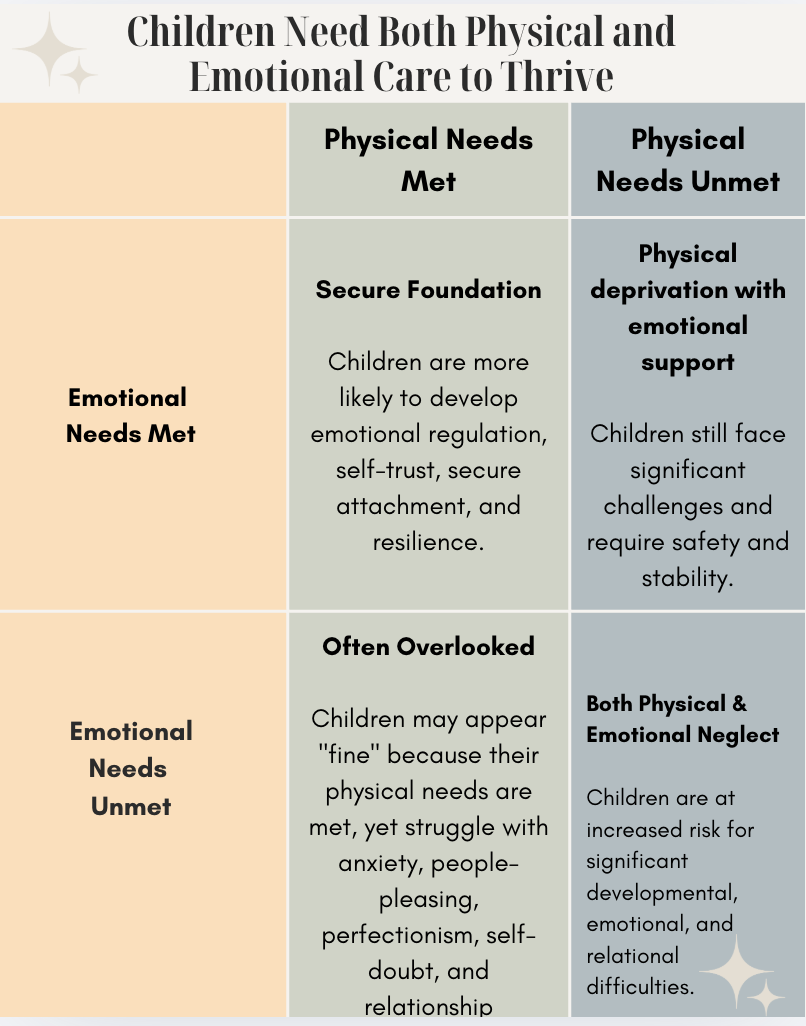
Many adults raised by emotionally immature parents had their physical needs consistently met while important emotional needs were met inconsistently or not at all. Because emotional neglect is often defined by what was missing rather than what happened, it can be difficult to recognize its lasting impact. Understanding this distinction can help explain why many adults struggle with anxiety, people-pleasing, perfectionism, self-doubt, or relationship difficulties despite describing their childhood as "good."

Signs You May Have Been Raised by Emotionally Immature Parents
Constantly worry about disappointing others
Second-guess yourself and seek reassurance
Feel lonely even when surrounded by others
Struggle to identify your own needs and feelings
Have trouble trusting yourself or making decisions
Feel guilty when prioritizing yourself
Feel responsible for other people's emotions
Experience anxiety, perfectionism, or chronic stress
Find yourself repeating familiar relationship patterns
Have difficulty setting or maintaining boundaries
Become the "caretaker" in relationships
Feel grief, anger, or confusion about your family relationships
These patterns often developed as ways to adapt and survive in your family system. They made sense then. They may simply no longer serve you now.

"I had a good childhood... so why do I still feel like something crucial was missing?"
Why Is It So Hard to Recognize Emotional Immaturity in Parents?
One of the most confusing aspects of growing up with emotionally immature parents is that many adults don't immediately recognize that their experiences affected them.
You may find yourself thinking:
"But they loved me."
"I had a good childhood."
"Nothing terrible happened."
"Other people had it much worse."
"My parents did the best they could."
All of these things can be true while also acknowledging that your emotional needs were not consistently met.
Many adult children of emotionally immature parents experienced what is often referred to as childhood emotional neglect. Unlike more obvious forms of trauma, emotional neglect is often defined not by what happened, but by what was missing.
Perhaps no one helped you understand your feelings. Maybe your emotions were dismissed, minimized, criticized, or ignored. You may have learned to become highly independent, responsible, or attuned to the needs of others because there wasn't enough space for your own emotional experience. Often these individuals feel alone.
This can make it difficult to identify why you struggle with anxiety, people-pleasing, perfectionism, self-doubt, or relationships as an adult. You may know that your parents cared about you while simultaneously feeling that something important was absent.
Recognizing the impact of emotional immaturity is not about blaming your parents or deciding that your childhood was "bad." It's about understanding how your experiences shaped you so that you can begin relating to yourself with greater compassion, clarity, and trust.
How Growing Up With Emotional Immaturity Can Impact Adult Relationships
Many adult children of emotionally immature parents become highly attuned to the needs and emotions of others while losing connection to their own internal experience. Many adult children of emotionally immature parents spend years wondering why they struggle with self-trust, boundaries, anxiety, and relationships despite appearing highly functional.
This can show up as:
People-pleasing and fawning
Difficulty saying no
Fear of conflict or abandonment
Over-functioning in relationships
Anxiety in dating or partnerships
Feeling responsible for keeping the peace
Choosing emotionally unavailable partners
Struggling to trust yourself or others
You may intellectually understand that you deserve more while emotionally feeling stuck in familiar patterns.. Therapy can help bridge that gap.
My Approach to Therapy for Adult Children of Emotionally Immature Parents
Somatic Experiencing (SE): Helping you understand and regulate your nervous system's responses to stress, attachment wounds, and relational trauma.
EMDR Therapy: Supporting the processing of painful experiences and longstanding beliefs about yourself.
Parts Work and Attachment-Based Therapy: Exploring the different parts of yourself that developed to protect you and helping create greater internal safety and self-compassion.
Relational and Trauma-Informed Therapy: Building a therapeutic relationship where your emotions, needs, and experiences can be understood and validated.
Together, we'll work to help you:
Understand how your childhood experiences shaped your present relationships
Reduce anxiety, guilt, and self-doubt
Strengthen boundaries without overwhelming guilt
Learn to identify and trust your own feelings and needs
Develop healthier, more fulfilling relationships
Build a stronger sense of self
Create greater emotional safety and self-compassion
Healing Doesn't Mean Your Childhood Was "Bad"
Many of my clients struggle because they don't believe their experiences were "bad enough" to deserve support.
The reality is that emotional neglect and emotional immaturity can be deeply impactful, even when there was love, good intentions, or periods of closeness.
You don't need to justify your pain in order to heal from it.

Looking for Support in a Group Setting?
In addition to individual therapy, I also offer an Adult Children of Emotionally Immature Parents Process Group for adults who want to connect with others who share similar experiences.
This virtual therapy group provides a supportive space to:
Understand the lasting impact of emotionally immature parenting
Reduce feelings of isolation and self-doubt
Practice healthier boundaries
Explore relationship patterns in a safe environment
Build greater self-trust and emotional resilience
Interested in joining?
Frequently Asked Questions
-
Yes. Many emotionally immature parents love their children deeply but lack the emotional skills, self-awareness, or capacity to consistently meet their child's emotional needs.
-
For many people, growing up with emotionally immature parents can create relational trauma, attachment wounds, chronic anxiety, people-pleasing patterns, and difficulties trusting themselves and others.
-
Absolutely. Therapy is not about deciding whether to maintain or end a relationship. It's about helping you understand your experiences, establish healthy boundaries, and make choices that align with your values and wellbeing.
-
Many adult children of emotionally immature parents learned early that maintaining connection required prioritizing others' emotions over their own needs. Therapy can help you understand and work through the guilt that often accompanies healthier boundaries.